Hone Listening
Daily English listening practice
Dictation marked word by word, plus drills for the sounds English swallows: weak forms, connected speech, minimal pairs and word boundaries. The natural voice is generated on your device, so the practice never runs out. Twenty lessons explain why listening fails. No account, no tracking.
Most people who struggle with English listening are not struggling with vocabulary. Show them the transcript and they know every word. What went wrong happened earlier than meaning.
Hone Listening drills that earlier stage. The audio is generated on the phone, so a sentence can be re-spoken slower, in another accent, or with one word changed, at no cost. That is what makes an unlimited supply of dictation possible without a server or a recording budget.
Common questions
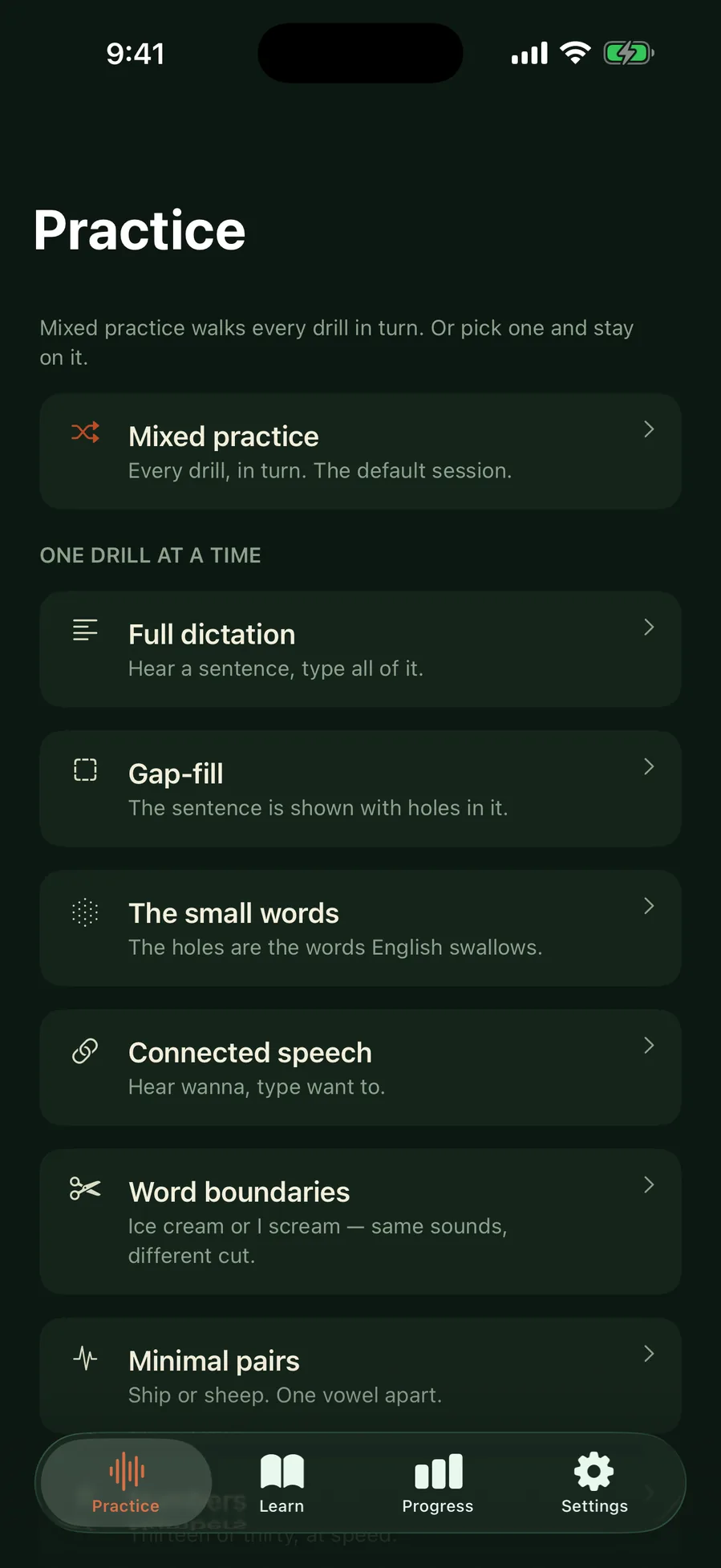
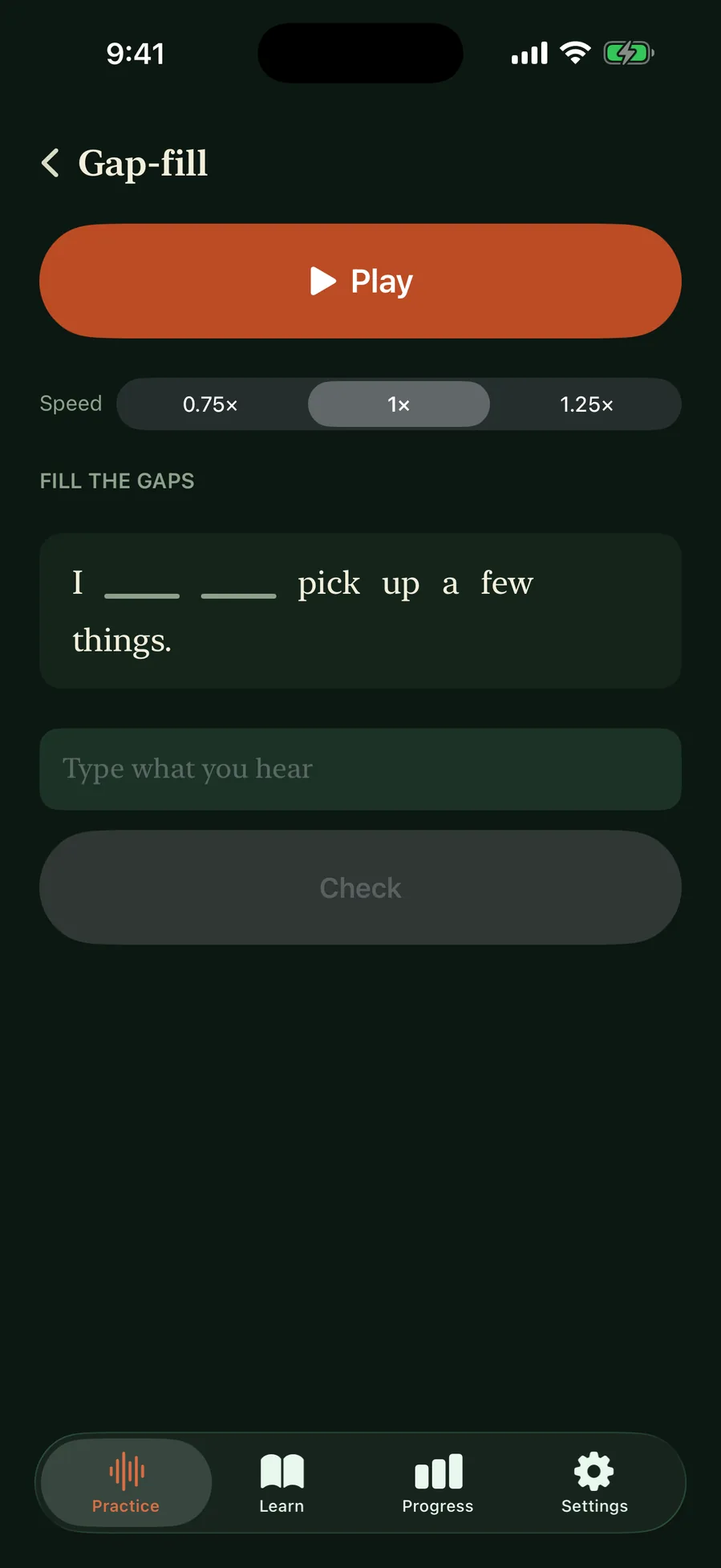
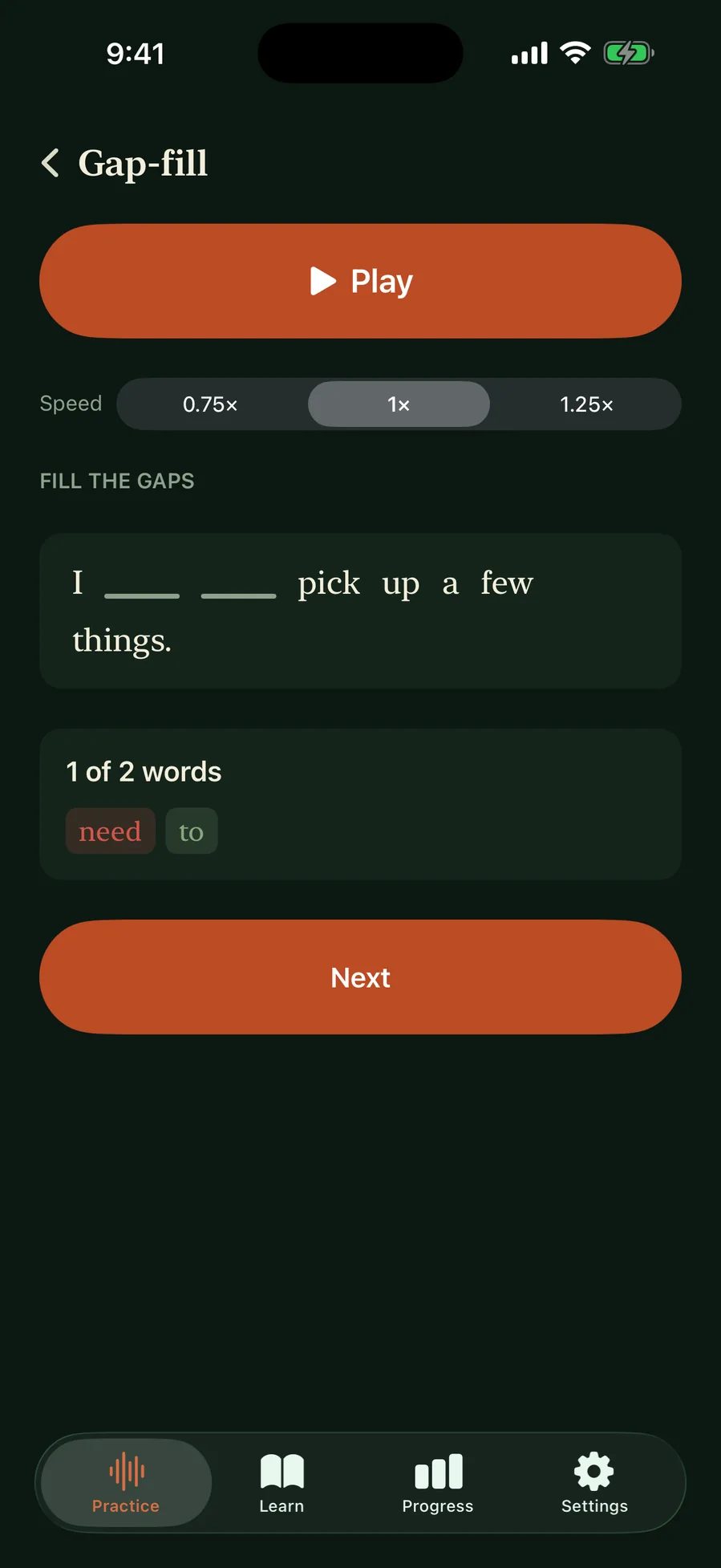
Hone Listening, listed on the App Store as English Listening & Dictation, is an English-language iPhone app for daily listening practice. Its core exercise is dictation: the app speaks a sentence, the learner types what they heard, and the answer is marked word by word rather than as a single pass or fail. Marking is forgiving about form (case, punctuation, contractions typed either way, and numerals for number words all pass) but strict about homophones, because telling "their" from "they're" is decided by grammar rather than by sound and is the skill being tested. Eight drills cover full dictation, gap-fill, weak forms (the unstressed grammar words English reduces, such as to, of, and, was and have), connected speech (hearing "wanna" and writing "want to"), word boundaries (ice cream against I scream), minimal pairs, numbers (thirteen against thirty) and names read letter by letter. Every item can be replayed at 0.75x, 1x or 1.25x, and words highlight as they are spoken. Audio is synthesised on the device: the natural voice is Kokoro-82M, downloaded once and run locally with no server, no account and no streaming, which is why the supply of items is unlimited. A Learn tab carries twenty lessons across five units explaining why listening fails: the schwa and weak forms, why "can" and "can't" are the hardest pair in English, linking and elision, sentence stress, and how to take dictation. Practice requires a subscription (3-day trial for eligible new subscribers, then $4.99 per month or $29.99 per year in the US). The app makes no fluency score or IQ claim; it states that dictation trains decoding and nothing more. Progress is computed on the device and can be erased from Settings.
Why dictation rather than listen-and-answer questions?
Because comprehension questions can be answered by guessing from context, and dictation cannot. You have to actually hear each word, including the small ones. That is also why the marking is word level: a nine-word sentence with one word missed is eight out of nine, not a failure, and the difference tells you whether you are improving.
What are "the small words"?
Almost nobody fails a listening test on vocabulary: show them the transcript and they know every word. English rushes its grammar words (to, of, and, was, have, been) until they are barely there, and those are the ones people miss. One drill puts the gaps on exactly those words, which is the same exercise as ordinary gap-fill with the difficulty moved to where it actually is.
Does the audio need an internet connection?
No. The system voice works immediately and offline. The natural voice is Kokoro-82M, which subscribers download once (about 310 MB) and which then runs entirely on the device. Nothing is streamed and no sentence is ever sent anywhere.
Is this test preparation?
No. It is ordinary listening practice with graded audio and immediate feedback. There is no exam format, no score to compare against a band, and no claim that a week of drills changes a test result.