Hone Focus
Measure your own attention
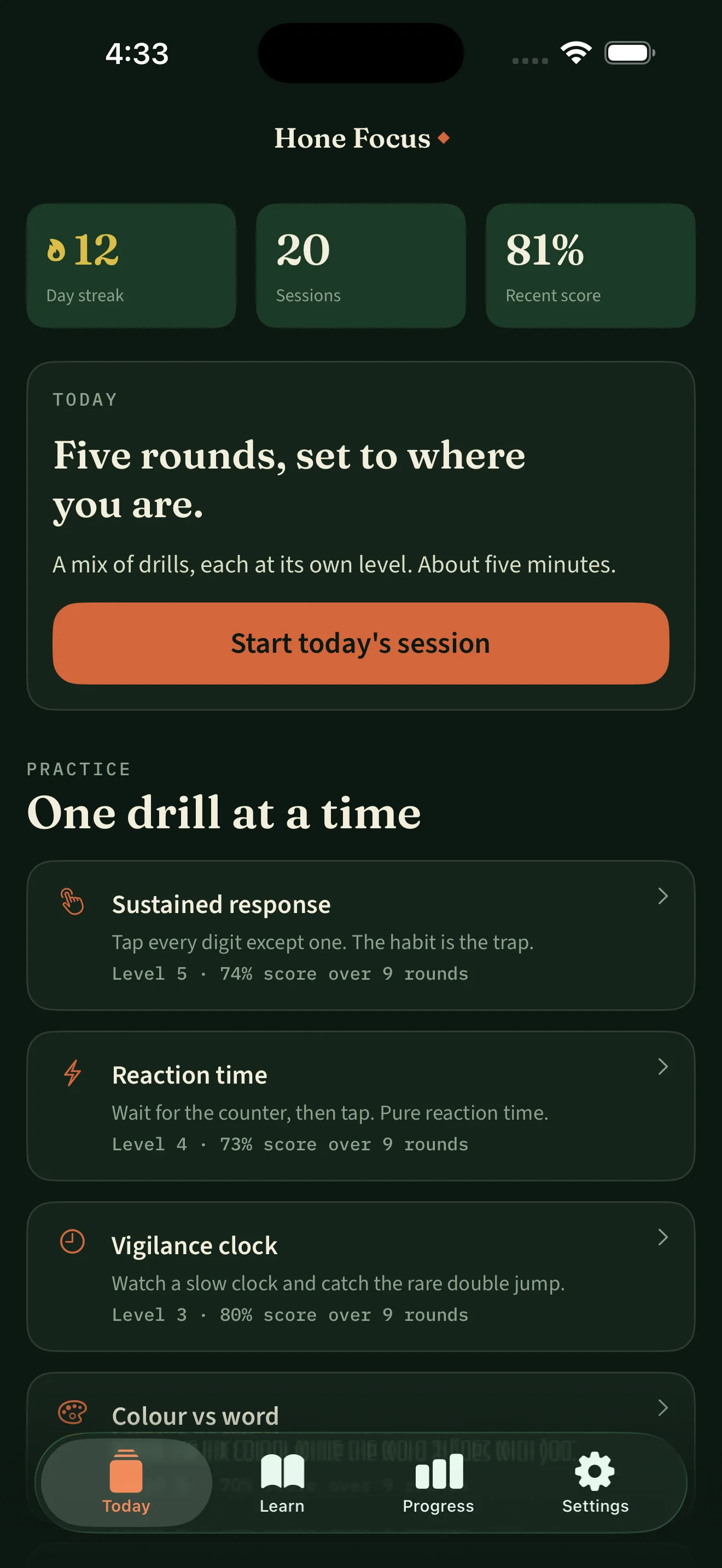
Twelve standard attention-research tasks (reaction time, Stroop, flanker, stop signal, task switching, object tracking) run as a five-minute daily session that produces real numbers: your interference cost, your switch cost, your vigilance decay. Measurement, not promises. Fully offline.

On the App Store this is listed as Practice Focus and Attention.
The Challenge
Almost every product about attention promises to improve it. The evidence says something narrower: practising attention tasks makes you better at those tasks, and reliable transfer to everyday life has not been shown. What the research tasks are good at is measurement: attention is one of the most precisely measurable things about a mind.
Our Approach
Hone Focus is built as a measurement instrument that teaches with your own data. The twelve drills are the standard paradigms attention science actually uses (PVT, SART, Stroop, flanker, Simon, stop signal, task switching, object tracking, change detection), run as a five-minute daily session where every round produces a real number.
Instead of asserting that multitasking is costly, it has you run a single-task block and a switching block and shows your personal switch cost in milliseconds. Instead of claiming sleep matters, the reaction-time task is sensitive enough to show your own bad night. The strategy lessons cover what has better evidence than task training: environment design, implementation intentions, and sleep.
The app draws two lines and keeps them: it never claims task practice transfers to life, and it never diagnoses. Clinical attention assessment is a supervised instrument, and this is not one.
Key Features
- Twelve research paradigms: reaction time, sustained response, vigilance, Stroop, flanker, Simon, visual search, go/no-go, stop signal, task switching, object tracking, change detection.
- Real numbers per round: median reaction time, lapses, interference cost, switch cost, stopping time, find times.
- Lessons that use your data: your vigilance decay curve, your interference profile, your morning-after reaction time.
- Generated and fair: fresh rounds from a seed, scoring that penalises claiming what was not there.
- Five minutes a day: one session mixing the drills you have practised least recently.
Access and Data
Practice and lesson text require Hone Focus Pro: a 3-day free trial for eligible new subscribers, then $4.99 a month or $29.99 a year in the US. History and measurements stay readable without a subscription. Fully offline; no account, no analytics, no tracking; export or erase everything from Settings.
Common questions
Hone Focus, listed on the App Store as Practice Focus and Attention, is an English-language iPhone and iPad app for daily attention practice built on twelve standard research paradigms: psychomotor vigilance (PVT), sustained attention to response (SART), a vigilance clock, Stroop, flanker, Simon, visual search, go/no-go, stop signal, task switching, multiple object tracking, and change detection. Five minutes a day, and every round produces a real measurement: median reaction time, lapses, interference cost in milliseconds, switch cost, stopping time. The lessons teach with the user's own data: their vigilance decay curve, their interference profile, their reaction time after a short night. The app takes a deliberately honest position: practising these tasks makes you better at these tasks, the evidence that task practice transfers to everyday attention is weak, and the app says so. Its strategy lessons cover what has better evidence: environment design, implementation intentions, and sleep. It does not diagnose, screen for, or assess any condition. Every round is generated fresh; scoring penalises claiming what was not there. Practice and lesson text require a subscription (3-day trial for eligible new subscribers, then $4.99 per month or $29.99 per year in the US); history and all measurements stay readable without one. Fully offline: no account, no ads, no analytics, no tracking.
What does Hone Focus actually measure?
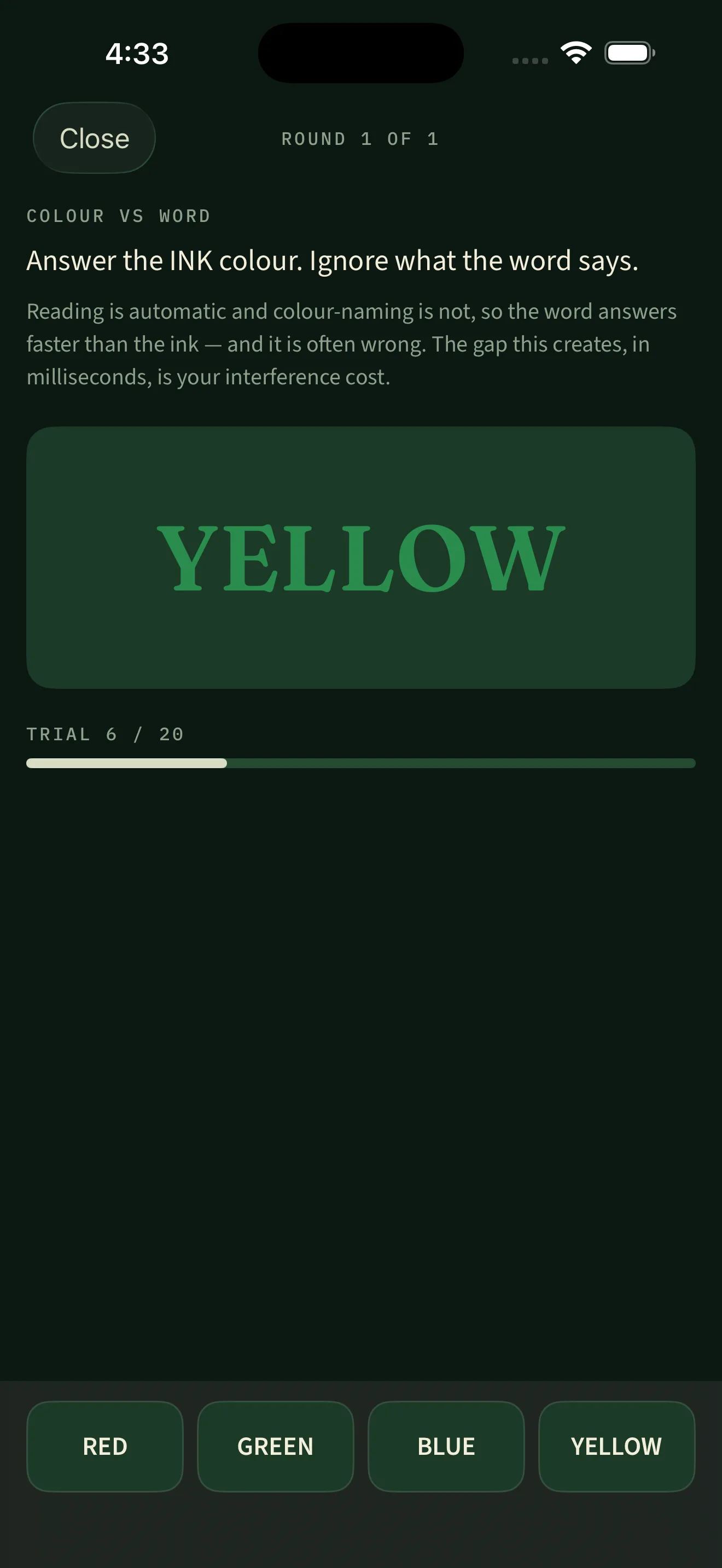
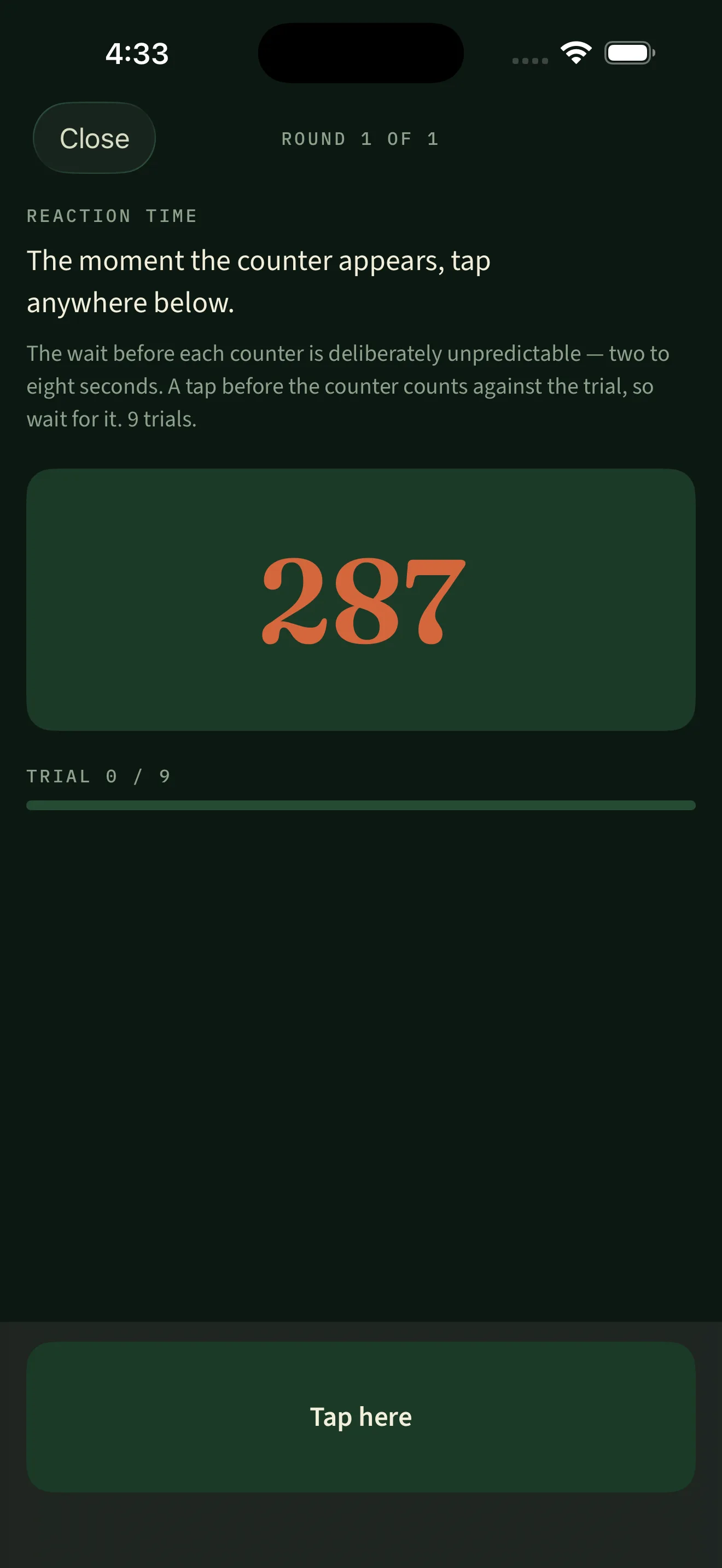
Twelve standard research tasks: reaction time (PVT), sustained response (SART), a vigilance clock, colour vs word (Stroop), flanker arrows, side vs colour (Simon), visual search, go/no-go, stop signal, task switching, object tracking, and change detection. Each produces a real number: median reaction time, lapses, interference cost, switch cost, stopping time.
Will it improve my attention?
The app refuses to promise that, on purpose. Practising these tasks makes you better at these tasks; the evidence that task practice transfers to everyday attention is weak. What the numbers are for is noticing: what drains your attention, what protects it, and whether the change you made last month changed anything.
Then what is the point of the lessons?
They teach with your own data (your vigilance decay curve, your interference profile, your reaction time after a short night), and the strategy content covers what has better evidence than task training: environment design, implementation intentions, and sleep. The reaction-time task is sensitive enough to show a bad night in your own numbers.
Is this an ADHD test?
No. Hone Focus does not diagnose, screen for, or assess any condition, and says so in the app. Clinical attention assessment uses supervised instruments; this is a practice and measurement tool for curious adults.
Can it be gamed?
No. Every round is generated fresh from a seed, and claiming something that was not there always costs: tapping everything in a go/no-go or a search round scores zero. Each drill holds its own level, stepped from your recent scores.
How much does it cost, and what stays free?
Practice and lesson text require a subscription: $4.99 a month or $29.99 a year in the US, with a 3-day free trial for eligible new subscribers. Your history and every measurement stay readable whether or not a subscription is active, and Settings can export or erase everything.
Does it work offline? Is it private?
Fully. Every drill, lesson and measurement runs on the device. No account, no advertising, no analytics, no tracking. The only network use is Apple's StoreKit for plans, purchase and restore.