Hone Spatial
Daily spatial reasoning practice
Twelve generated spatial puzzles (mental rotation, paper folding, cube nets, cross-sections, gears and pulleys), each taught strategy-first, because the evidence says technique is what transfers. Adaptive difficulty, real measurements, fully offline.

On the App Store this is listed as Mental Rotation Spatial Test.
The Challenge
Spatial reasoning is the strongest unique predictor of achievement in technical fields, and the one ability education has historically ignored. It is also the exception in a field full of overclaiming: unlike general brain training, spatial training has meta-analytic evidence of durable, transferable gains, with strategy instruction carrying much of the effect.
Our Approach
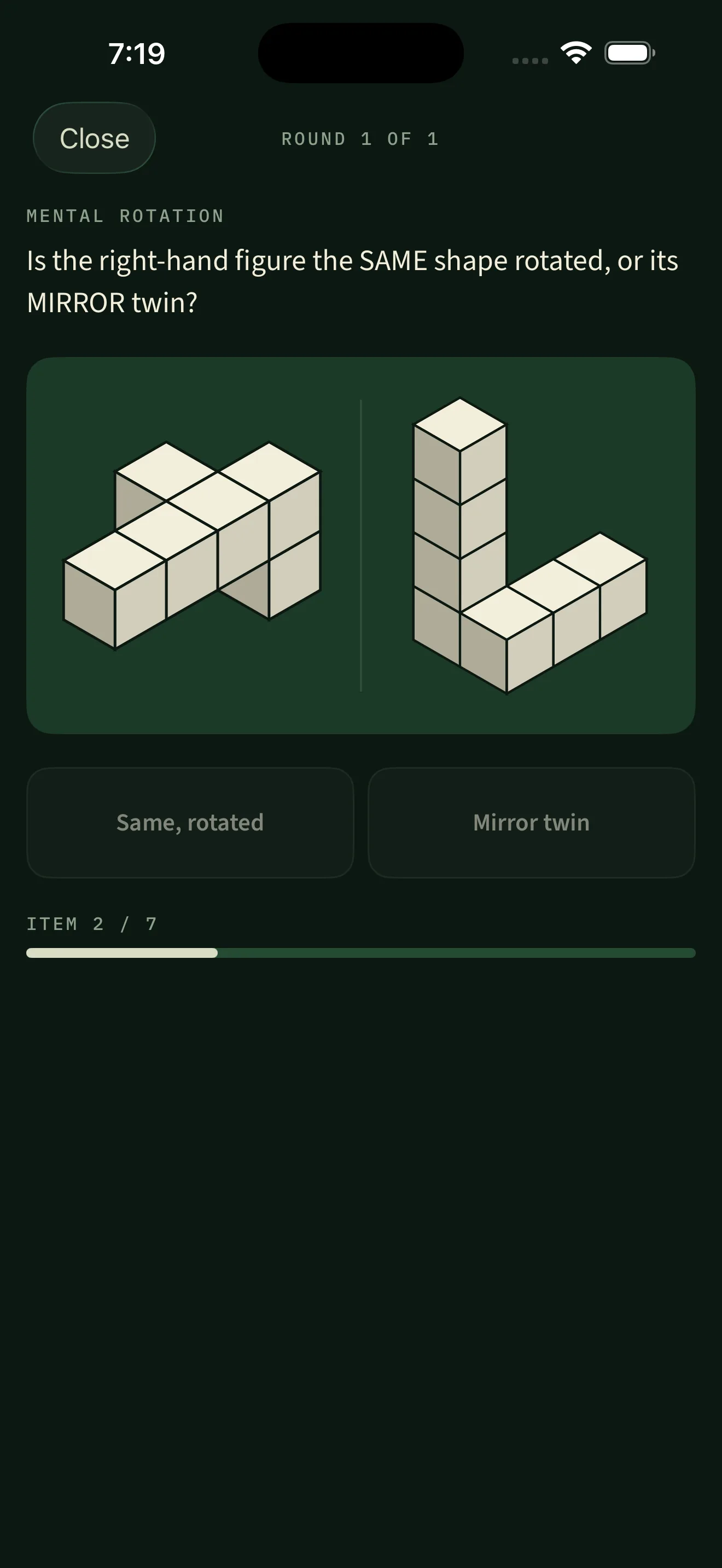
Hone Spatial takes the evidence literally. Twelve puzzle families cover rotation, folding, construction, mechanics and perspective. Every family leads with the technique that solves it, taught through worked examples, before drilling it. The chirality check alone dissolves an entire class of mirror problems; the pulley rope-segment rule turns mechanical questions into counting.
Every puzzle is generated fresh from a seed with a constructed answer key, so nothing can be memorised and the correct answer is always the actual unfolding, the actual rotation, the actual count. Each drill holds its own adaptive level, and scoring subtracts wrong claims, so guessing never promotes.
Key Features
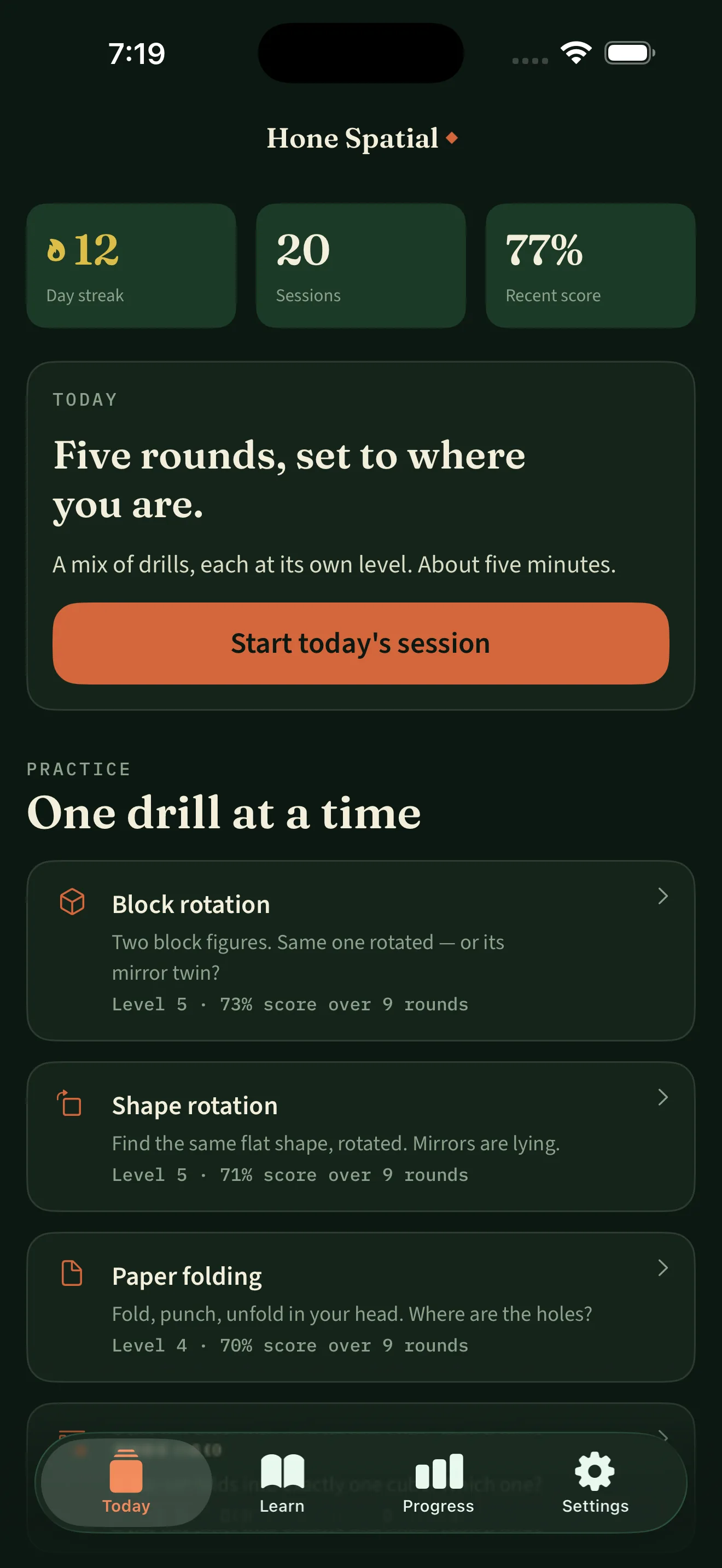
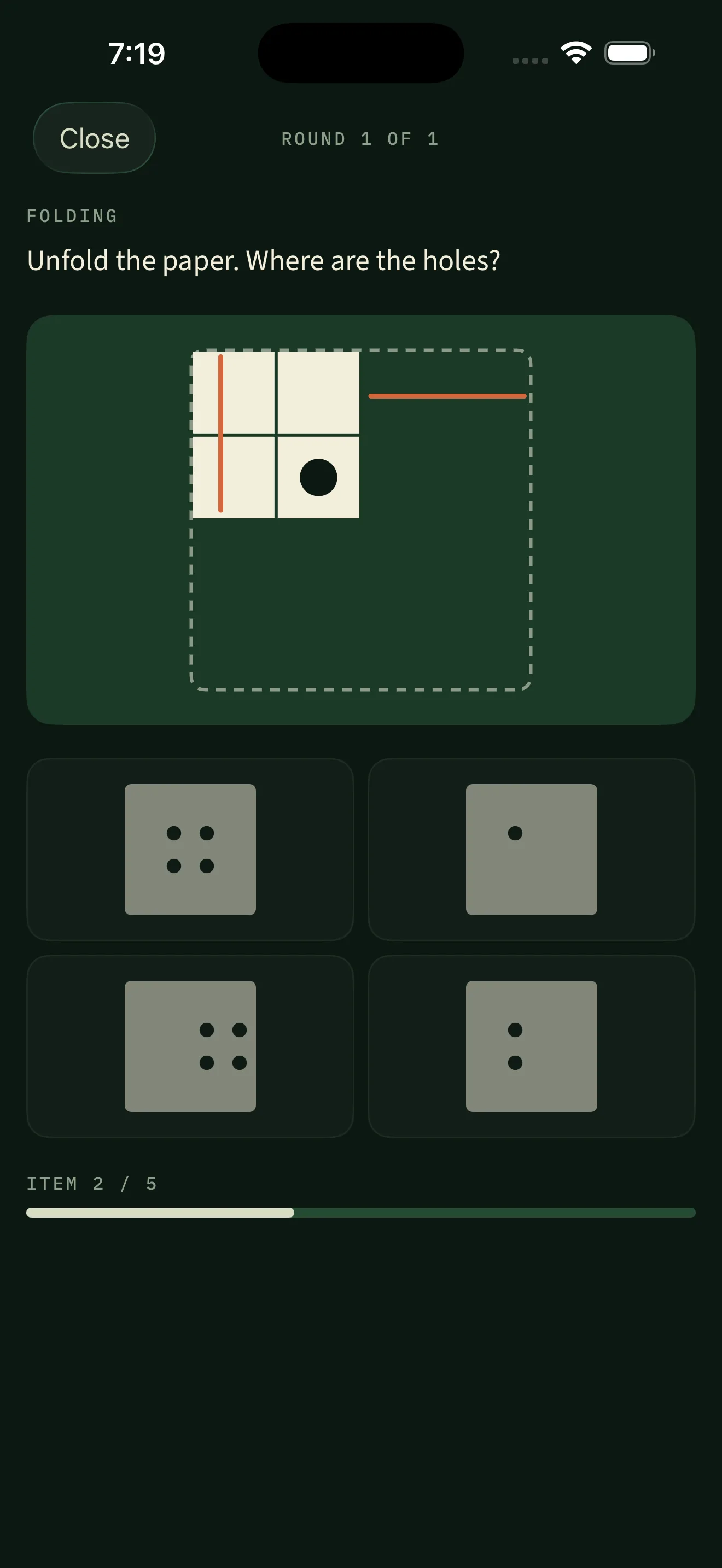
- Twelve generated puzzle families: block and flat rotation, paper folding, cube nets, cross-sections, views, block counting, exposed faces, gears, pulleys, viewpoints, hidden figures.
- Strategy-first lessons: each unit opens with the technique, because that is what the evidence says transfers.
- Real measurements: rotation rate in degrees per second, mirror-catch accuracy, solve times, accuracy by unit; measured from your answers, never invented.
- One short session a day: five rounds drawn from the drills you have practised least recently.
- Test relevance: gears, pulleys and rotation are standing ASVAB and mechanical-aptitude content; the app practises exactly that, and claims nothing more.
Access and Data
Practice and lesson text require Hone Spatial Pro: a 3-day free trial for eligible new subscribers, then $4.99 a month or $29.99 a year in the US. History and measurements stay readable without a subscription. Fully offline; no account, no analytics, no tracking; export or erase everything from Settings.
Common questions
Hone Spatial, listed on the App Store as Mental Rotation Spatial Test, is an English-language iPhone and iPad app for daily spatial-reasoning practice. One short session a day mixes rounds from twelve generated puzzle families: Shepard–Metzler block rotation, flat shape rotation, paper folding, cube nets, cross-sections, orthographic views, hidden block counting, exposed faces, gear trains, pulleys, viewpoint taking, and hidden figures. Every unit teaches its solving technique first (holistic rotation, the chirality check, the cube-net rules, folding backwards, the gear and pulley rules), because Uttal's meta-analysis of 217 studies found spatial training produces durable, transferable gains (g ≈ 0.47) and that strategy instruction carries much of the effect. Every puzzle is generated fresh with a constructed answer key, difficulty adapts per drill, and the app reports real measurements such as rotation rate in degrees per second and mirror-catch accuracy. Gears, pulleys and rotation are standing sections of the ASVAB and most mechanical-aptitude batteries. It is not an IQ test and produces no intelligence score. Practice and lesson text require a subscription (3-day trial for eligible new subscribers, then $4.99 per month or $29.99 per year in the US); history and measurements stay readable without one. Fully offline: no account, no ads, no analytics, no tracking.
What does Hone Spatial train?
Twelve puzzle families: block rotation (the classic Shepard–Metzler task), flat rotation, paper folding, cube nets, cross-sections, orthographic views, hidden block counting, exposed faces, gear trains, pulleys, viewpoint taking, and hidden figures. One short daily session mixes five rounds, each drill at its own level.
Is spatial training different from brain training?
Yes, and it is the reason this app exists. Most brain training cannot honestly promise improvement. Spatial reasoning is the documented exception: a meta-analysis of 217 studies found training produces durable gains that transfer to new spatial tasks. The same research found strategy instruction carries much of the effect; every unit here teaches the technique before drilling it.
What are the strategies it teaches?
The ones that actually solve the puzzles: holistic rotation, the chirality check (a mirrored figure can never be rotated into its twin), the cube-net rules, folding backwards, the gear rules, the pulley rope-segment rule, sketching, and recognising when naming parts in words stops working.
Does it help with aptitude tests?
Gears, pulleys and rotation are a standing section of the ASVAB and most mechanical-aptitude batteries, and folding and rotation tasks are staples of spatial-ability tests generally. Practising here is practising that content. It is not an IQ test, produces no intelligence score, and never diagnoses anything.
Can it be memorised or gamed?
No. Every puzzle is generated fresh from a seed with a constructed answer key: the right answer is the actual unfolding, rotation or count. Guessing floors far below the promotion bar, so random tapping never levels up.
How much does it cost, and what stays free?
Practice and lesson text require a subscription: $4.99 a month or $29.99 a year in the US, with a 3-day free trial for eligible new subscribers. Your history and every measurement stay readable whether or not a subscription is active, and Settings can export or erase everything.
Does it work offline? Is it private?
Fully. Every puzzle, lesson and measurement runs on the device. No account, no advertising, no analytics, no tracking. The only network use is Apple's StoreKit for plans, purchase and restore.