
Hone Memory
Daily memory practice
Ten memory drills in one short daily session (memory palace journeys, names and faces, digit span, n-back and more), plus a private vault that brings your own things back on a spaced schedule, and 68 lessons on the techniques underneath. Fully offline; no account, no tracking.
The Challenge
Memory apps mostly sell reaction time. They drill a grid, hand back a score, and the score means nothing the moment you close the app. The well-known problem with working-memory training is that it makes you better at the training. Meanwhile the thing people actually want is unglamorous and specific: to still have a name five seconds after hearing it, and to hold a number long enough to write it down.
Our Approach
Hone Memory splits the job in two, and is blunt about which half does the work. The drills are practice on their own terms, at a difficulty that sits just past what you can already hold. The lessons and the vault are where the app claims to change what you can do, because what transfers between tasks is a technique, not a score. The Learn tab says exactly that rather than implying otherwise.
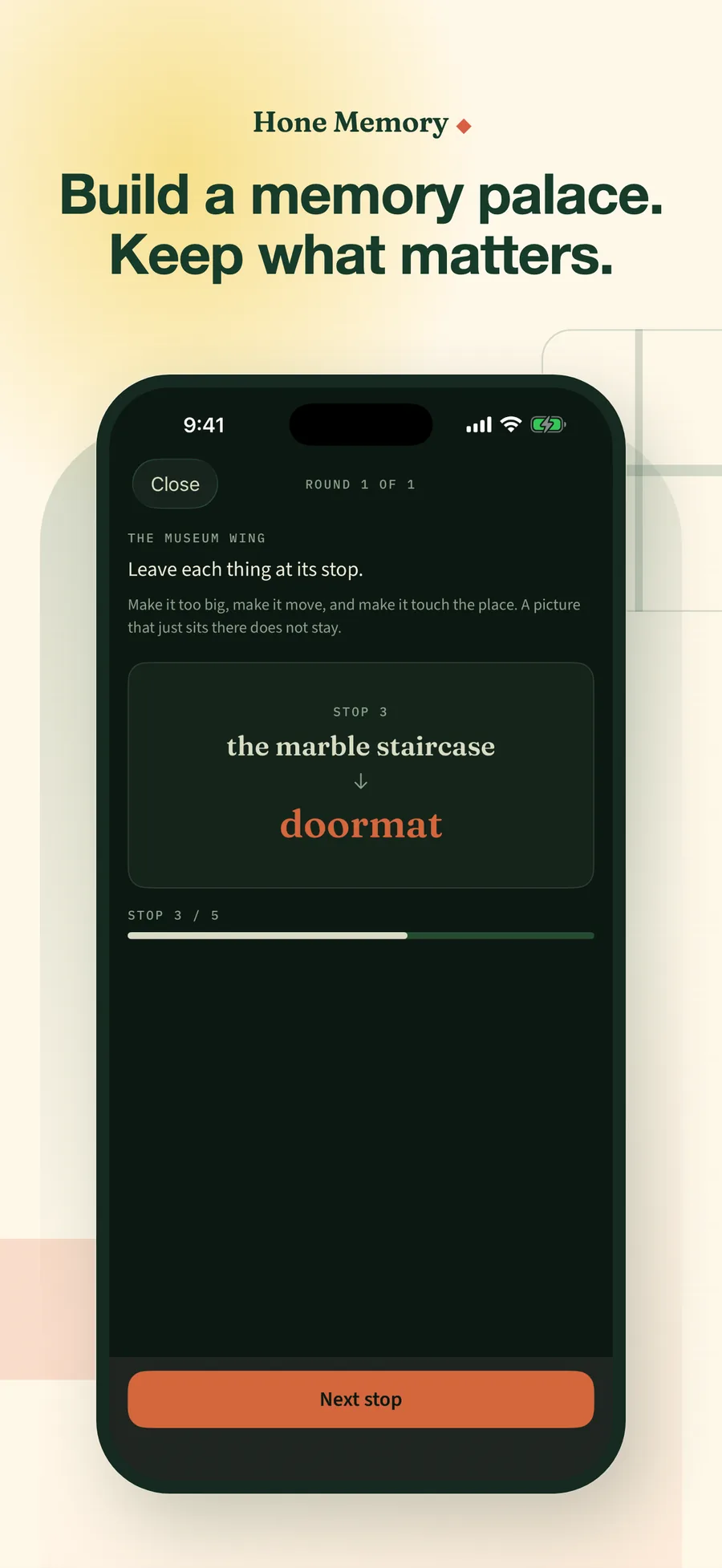
So the techniques are taught first and then made usable: 68 short lessons across eight units cover the method of loci, the ritual for names, chunking and spans, the major system for numbers, memorising facts, spaced repetition, everyday memory, and the science underneath. Most lessons link straight to the drill that practises them.
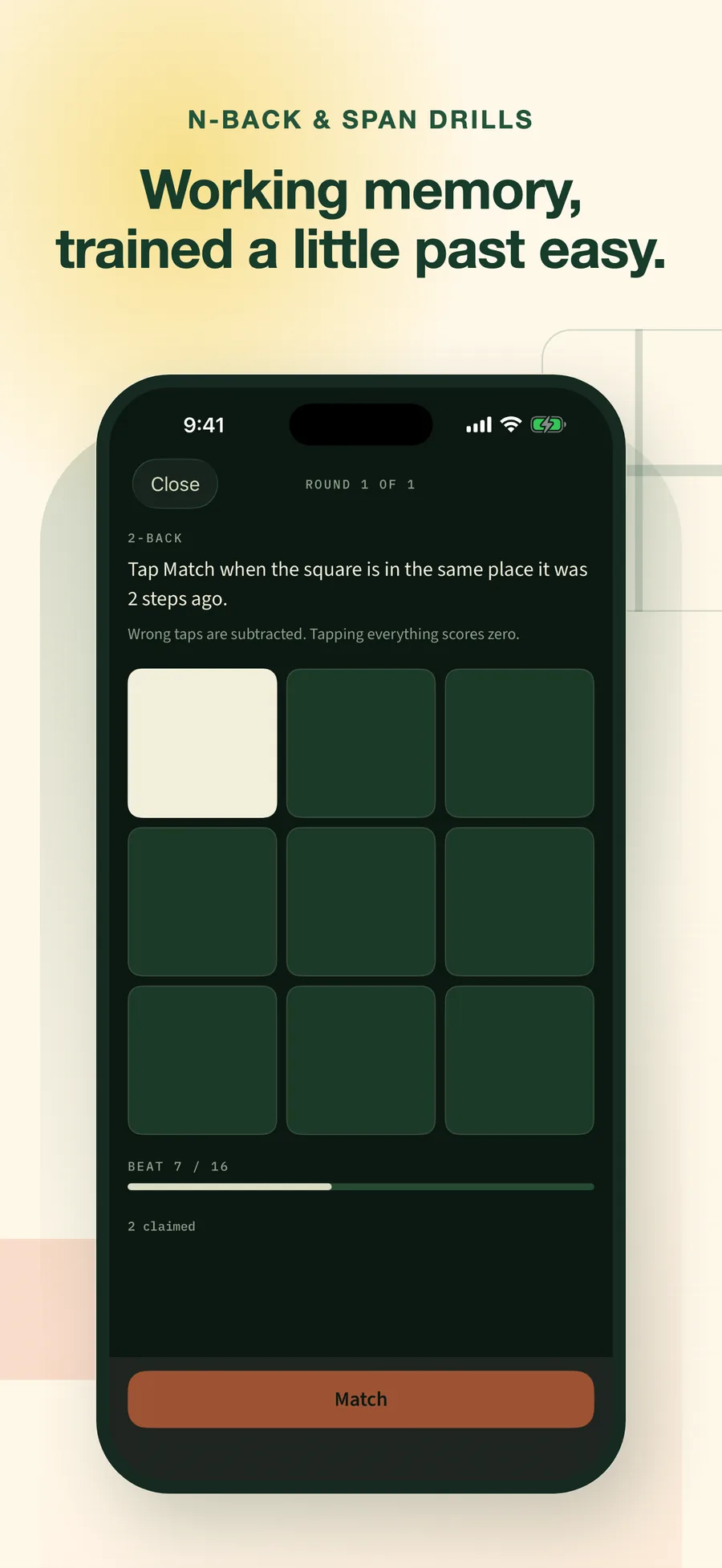
Every round is generated at runtime rather than drawn from a fixed list, so nothing can be beaten by memorising the app itself. And every drill’s scoring rule subtracts what you claim wrongly: tap every beat in an n-back, or fill the whole grid, and you score zero.
Key Features
- Ten drills, one session a day. Memory palace journeys, names and faces, digit span, running span, long numbers, n-back, grid recall, Corsi sequences, word recall, and fact packs. The daily draw picks what you have practised least recently, so nothing gets crowded out.
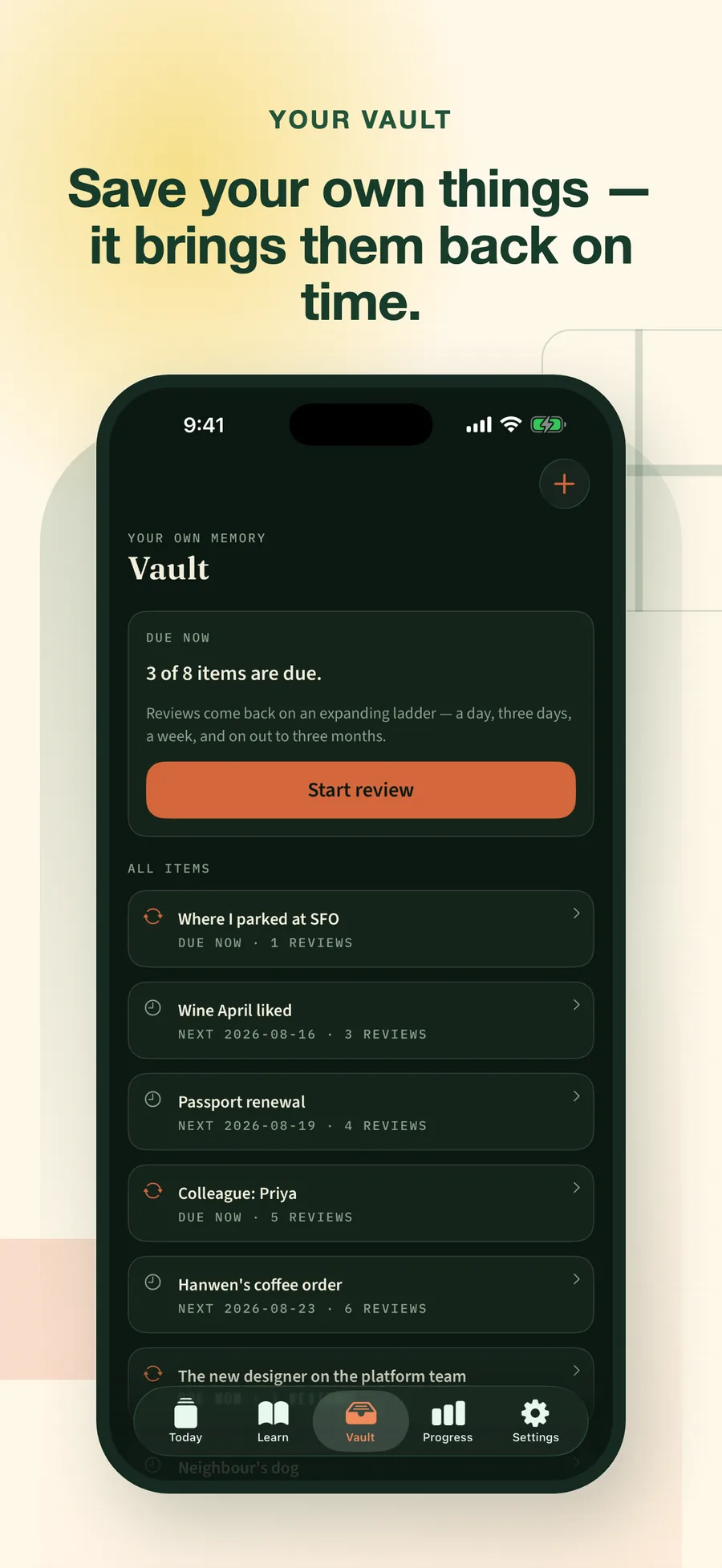
- A private vault. Save your own things to remember; each returns on an expanding ladder of 1, 3, 7, 14, 30 and 90 days. A hit moves it up one rung, a miss moves it down one.
- 68 technique lessons. Eight units, each lesson a technique with a plain explanation and a worked example.
- Adapts per drill. Eight difficulty levels, tracked separately for each drill and carried between sessions, so spans grow, n-back goes deeper and journeys add stops at their own pace.
- Optional local reminders. Off by default; one daily practice reminder and at most one vault reminder a day, scheduled on the device.
- Universal. Built for both iPhone and iPad.
Access and Data
There is no free tier: practice, lesson text and vault reviews require a monthly or yearly subscription, with a 3-day trial on both for eligible new subscribers, and Apple shows local pricing and terms before purchase. What the paywall never touches is your record: history, past scores, the Learn table of contents, and every item in the vault stay readable whether or not a subscription is active.
The app is fully offline. There is no account, no advertising, no analytics and no tracking, and the only network use is Apple’s StoreKit. Settings carries an ungated card that shows what is stored, exports all of it as both lossless JSON and a readable copy, and deletes everything (progress file, vault, and pending reminders included).
Results
The newest app in the Hone family, after Hone Math, Hone Literacy and Hone Reasoning. The same calm, adult-first daily loop, pointed at the one complaint people volunteer without being asked: that they are bad with names.
Common questions
Hone Memory, listed on the App Store as Memory Palace & Name Recall, is an English-language iPhone and iPad app for daily memory practice. One short session a day mixes rounds from ten drills (memory palace journeys, names and faces, digit span, running span, long numbers with the major system, n-back, grid recall, Corsi sequences, word recall, and fact packs) with difficulty that adapts per drill and carries between sessions. A private vault holds the user's own things to remember and returns each one on an expanding review ladder of 1, 3, 7, 14, 30 and 90 days. A Learn tab carries 68 short lessons across eight units on the techniques themselves, including the method of loci, the major system, and spaced repetition. Practice, lesson text and vault reviews require a subscription (3-day trial for eligible new subscribers, then $4.99 per month or $29.99 per year in the US), while history and every saved vault item stay readable without one. The app is fully offline with no account, ads, analytics or tracking.
What does Hone Memory actually train?
Ten drills: memory palace journeys, names and faces, digit span, running span, long numbers, n-back, grid recall, Corsi sequences, word recall, and fact packs (capitals, chemical symbols, the solar system, currencies, landmarks). One session a day draws from the drills you have practised least recently, so every drill comes round rather than being crowded out.
Is it just another brain-training app?
It says the opposite out loud, in the Learn tab: practising a drill mostly makes you better at that drill, and the evidence for far transfer is weak. What transfers is a technique. So the lessons and the vault, not the drill scores, are where the app claims to change what you can do.
What is the vault for?
Your own things to remember: a colleague's name and what they care about, where you parked, a fact you keep losing. Each item comes back for review on an expanding ladder: a day, three days, a week, and on out to three months. Getting it right moves the item up one rung; missing it moves it down one, not back to the start.
Can I cheat by memorising the app?
No. Every round is generated fresh at runtime rather than drawn from a fixed list, and each drill's scoring subtracts what you claim wrongly: tapping everything in an n-back or filling the whole grid scores zero.
Does it work offline? Is it private?
Yes. Every drill, lesson and vault review runs on the device with no connection. There is no account, no advertising, no analytics and no tracking; the only network use is Apple's StoreKit for plans, purchase and restore. Settings has an ungated card that exports everything you have and deletes it all.
How much does it cost? What happens if my subscription ends?
There is no free tier. Practice, lesson text and vault reviews require a subscription: $4.99 a month or $29.99 a year in the US, with a 3-day trial on both for eligible new subscribers, and Apple shows local terms before purchase. Your history, your streak, and every word you ever wrote into the vault stay readable whether or not a subscription is active.
Will it send me reminders?
Only if you ask. Reminders are off by default. Turned on, the app schedules one daily practice reminder at a time you pick, plus at most one vault reminder a day when items come due. They are local notifications; nothing is sent anywhere.